




Written by Zainub Pahad, Audiologist
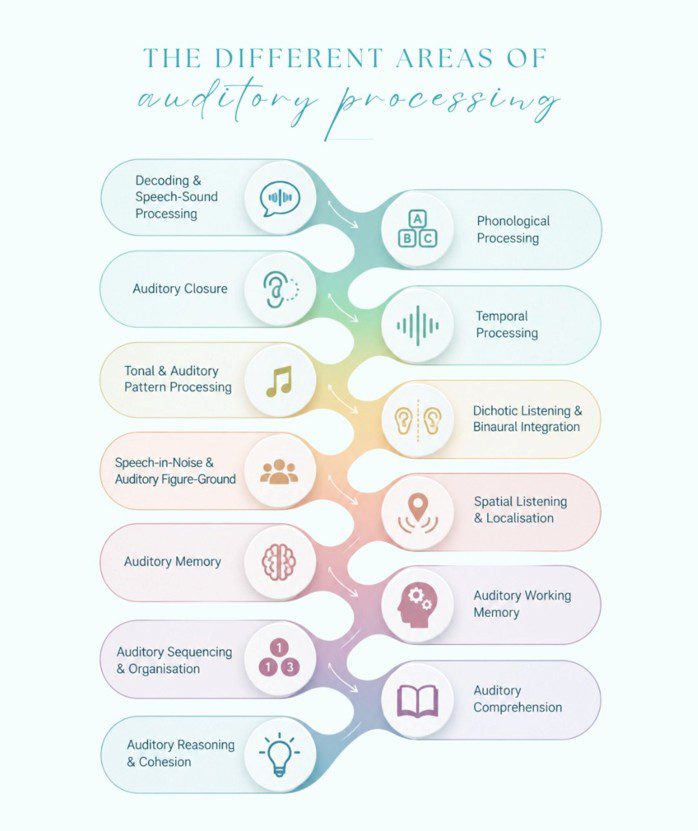
Auditory processing is not one single skill.
The auditory system performs several different jobs simultaneously, and a child may show strengths in some areas while having trouble in others.
Understanding these different areas helps explain why APD can look so different from one person to another.
Decoding and Speech-Sound Processing
Decoding refers to how accurately and efficiently the auditory system recognises speech sounds.
A child with difficulty in this area may:
- confuse similar sounds or words
- miss sounds within words
- struggle to break words into individual phonemes
- guess unfamiliar words instead of fully decoding them.
These difficulties can place additional demands on phonics, reading and spelling.
Auditory Closure
We rarely hear perfectly clear speech throughout the day.
A person may speak quickly, turn away while talking, stand at a distance, or their voice may be partly covered by background noise.
Auditory closure is the brain’s ability to use the information that is available to fill in the missing pieces.
A child with difficulty in this area may understand a word when it is clear, but struggle when the same word becomes muffled, fast, incomplete or partly masked.
Temporal Processing
Temporal processing involves recognising very small changes in the: timing, order, rhythm and pattern of sounds.
These skills help the auditory system make sense of rapidly changing auditory information.
Difficulty may become more apparent when information is presented quickly or when the child must process increasingly complex sound patterns.
Tonal and Auditory Pattern Processing
Auditory pattern processing involves recognising and remembering changes in pitch, rhythm and sound sequences.
These skills contribute to understanding the order and pattern of auditory information, particularly when increasingly complex sequences must be remembered.
Dichotic Listening and Binaural Integration
Both ears are constantly receiving information from the environment.
Dichotic listening involves processing different information reaching the two ears at the same time.
Binaural integration allows the brain to manage and combine information arriving from both sides.
These skills become particularly important during:
- classroom discussions
- group work
- conversations with several speakers
- situations where one person must be heard while another person is talking.
A child may have completely normal hearing in both ears but still struggle significantly when the brain is required to manage competing information from both sides.
Speech-in-Noise and Auditory Figure-Ground
Listening to a teacher in a quiet room is very different from listening while classmates are talking, chairs are moving and other sounds are occurring around the room.
Auditory figure-ground refers to the ability to focus on the important speech signal while filtering out competing sound.
A child with difficulty in this area may perform very well in a quiet one-to-one setting but struggle significantly in a busy classroom.
Spatial Listening and Localisation
The auditory system also uses information from both ears to determine where sound is coming from.
Knowing the location of a speaker helps the brain separate that voice from competing noise.
This is one reason a child may cope better when:
- seated close to the teacher
- able to see the teacher clearly
- the teacher is facing them
- the speaker’s location is easy to identify.
Auditory Memory
Auditory memory is the ability to retain information that has been heard.
A child may successfully remember:
“Take out your book.”
but struggle when the instruction becomes:
“Take out your maths book, turn to page 24, complete questions one to five and then bring your book to me.”
As the amount of auditory information increases, so does the memory demand.
Auditory Working Memory
Working memory goes a step further.
The child must not only remember what was heard but also hold and manipulate the information.
For example:
“Before you put the red ball in the box, pick up the blue pencil.”
The child must retain both pieces of information while reorganising the order in which they are completed.
Auditory Sequencing and Organisation
Auditory sequencing involves remembering information in the correct order.
It contributes to following instructions, remembering sound sequences, retelling stories and organising verbally presented information.
Auditory Comprehension
Auditory comprehension is the ability to understand spoken information.
This includes understanding:
- instructions
- stories
- explanations
- classroom information
- questions.
A child may remember individual details but still struggle to understand how those details fit together.
Auditory Reasoning and Cohesion
Some children understand information that is directly stated but struggle when they need to: infer, predict, identify cause and effect, connect ideas and explain why something happened.
These difficulties can become particularly noticeable during:
- reading comprehension
- classroom discussions
- examination questions
- story retelling
- verbal reasoning tasks.