




Written by Zainub Pahad, Audiologist
When we think about hearing, we often think about the ears. We imagine that if a child can hear a soft beep during a hearing test, then they should also be able to understand their teacher, follow a long instruction, remember what was said and cope in a noisy classroom.
But listening is far more complex than simply detecting sound.
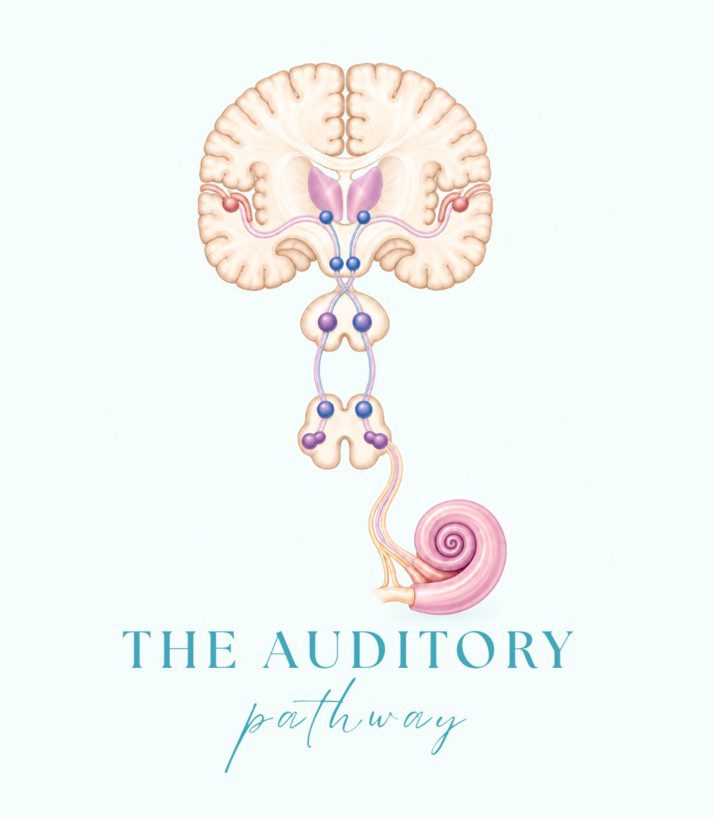
The ears are only the beginning of the journey.
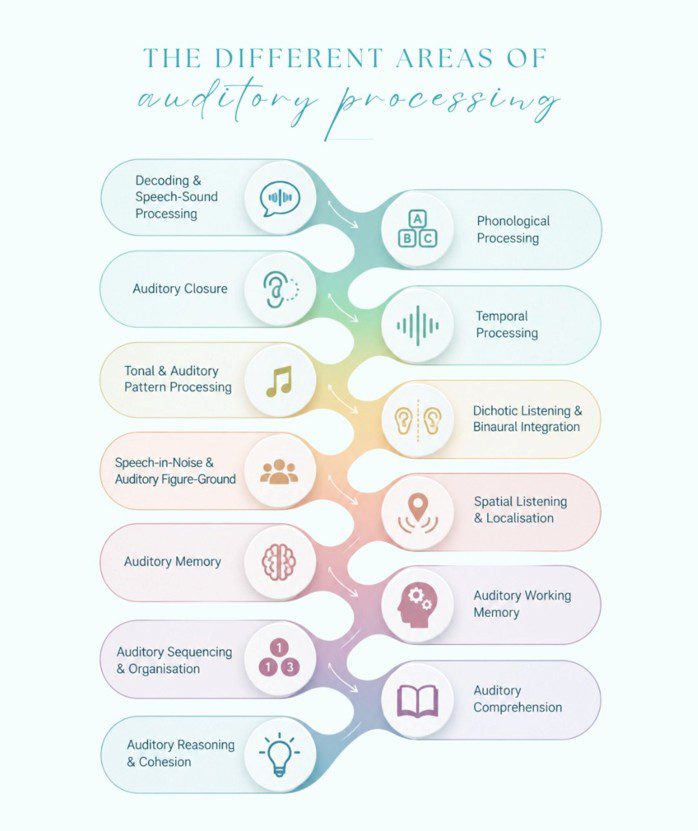
Once sound enters the auditory system, the brain must recognise it, separate important information from background noise, identify where it is coming from, analyse the timing and pattern of the sound, remember it, organise it and attach meaning to it.
This is where Auditory Processing Disorder (APD) comes in.
What is Auditory Processing Disorder?
Auditory Processing Disorder refers to difficulty with the way auditory information is processed within the central auditory nervous system.
A person with APD may have normal peripheral hearing, meaning that the ears can detect sounds at expected levels, but still have trouble making sense of auditory information, particularly when listening becomes more demanding.
In simple terms, hearing tells us whether sound reaches the ear. Auditory processing tells us what the brain can do with that sound once it gets there.
This is why APD can be thought of as a difficulty that occurs “beyond the ear.”
A child may hear the teacher’s voice but still struggle to accurately process everything that was said.
What can APD look like?
APD does not look the same in every child.
One child may struggle mainly in background noise. Another may have difficulty processing fast or unclear speech. A child may manage well during a quiet one-to-one conversation but struggle when several people are speaking, instructions become longer, or information needs to be remembered and reorganised.
Common difficulties may include:
- frequently asking for repetition
- mishearing similar-sounding words
- difficulty following longer or multi-step instructions
- difficulty remembering spoken information
- appearing distracted or “zoning out” during longer listening activities
- struggling in noisy classrooms or group situations
- finding fast or unclear speech difficult to follow
- difficulty identifying where a voice or sound is coming from
- difficulty when more than one person is speaking
- difficulties with phonological awareness, reading or spelling
- needing additional processing time
- performing better when visual support is available.
A child with APD may therefore appear inattentive when, the auditory system is working extremely hard to separate, organise and interpret incoming information.
Why can APD affect reading and spelling?
Learning to read and spell relies heavily on accurate auditory processing.
Children need to be able to: recognise speech sounds → separate words into phonemes → remember sound order → connect sounds with letters → hold auditory information in memory while using it.
If one or more of these skills is vulnerable, literacy tasks may require substantially more effort.
APD does not automatically mean that a child has dyslexia, and dyslexia does not automatically mean that a child has APD. However, the two may coexist.
For a child who already has a literacy difficulty, an auditory-processing weakness may therefore add another layer of difficulty to reading, spelling and phonological learning.
Looking beyond behaviour
When a child repeatedly asks “What?”, loses part of an instruction, struggles in a noisy classroom or takes longer to respond, it is important to consider what is happening after the sound has been heard.
Understanding APD allows us to move away from simply asking:
“Can this child hear?”
and instead ask:
“What happens to the information after they hear it?”
That shift helps us better understand the child’s listening experience and identify where targeted support may be needed.