




Start with what changed. We'll help you find the right hearing pathway.
Hearing care for babies, children and adults, organised around the real-life concern rather than expecting you to know which hearing test to request.
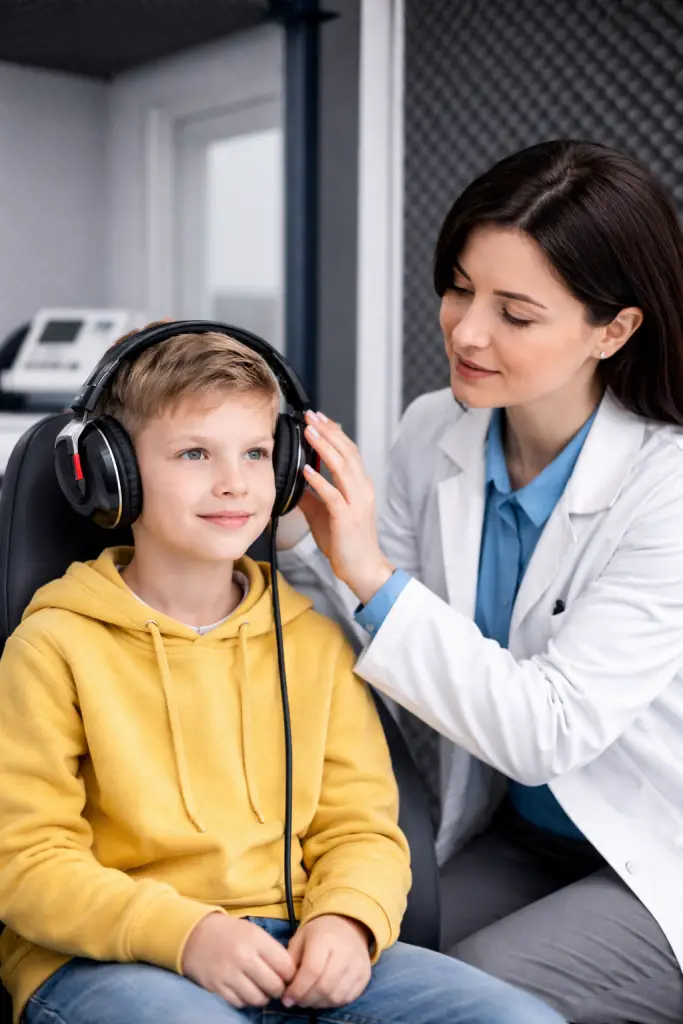
What are you noticing?
You do not need to identify the test or diagnosis. Choose the closest description and we will organise the next step.
Three questions. A clearer starting point.
This tool does not diagnose or replace medical triage. It helps organise the type of audiology pathway that may make sense based on age, concern and timing.
Diagnostic hearing assessment
Guidance only. Sudden or severe symptoms and medical emergencies require appropriate medical assessment.
Three hearing pathways, one cross-check principle.
The aim is reliable information, not forcing every patient through the same test battery.
Baby / young child
Testing can combine age-appropriate behavioural measures with objective cross-checks such as OAEs and AABR when clinically appropriate. Diagnostic ABR or referral is considered where indicated.
Child / teenager
Behavioural hearing testing is adapted to developmental age and response ability, with ear, middle-ear, speech and objective measures added where clinically appropriate.
Adult
The assessment starts with the hearing concern and ear status, then examines hearing sensitivity, speech performance and additional objective or referral pathways where needed.
We do not test one thing. We cross-check the hearing pathway.
Each part of the battery answers a different clinical question. The history and findings determine which parts are needed.
One audiology hub. Six connected routes.
Once the concern is clearer, move directly into the most relevant pathway without starting the search again.
Has the hearing changed suddenly or rapidly?
A sudden or rapidly worsening hearing change can require prompt medical assessment. New neurological symptoms, severe acute dizziness, significant ear trauma, severe pain or another medical emergency should not be managed as a routine hearing-test booking.
Understand. Assess. Plan.
A useful audiology appointment should explain the concern, the findings and what happens next.
Review symptoms, medical and hearing history, developmental or school information where relevant, and the situations in which hearing is most difficult.
Select the appropriate ear, middle-ear, behavioural, speech or objective measures rather than applying one identical battery to everybody.
Explain the results clearly and organise treatment, monitoring, hearing aids, reports or referral where clinically indicated.
Useful guidance without another appointment.
Choose a test and see what it generally examines, what it cannot prove on its own and useful questions for feedback.
Open Results Explainer → Appointment guideWhat to expect at a hearing test.Before, during and after the appointment.
Read the guide → PrepareBring the information that helps.A practical checklist for your appointment.
Prepare for your visit →Questions before an audiology appointment.
Do I need a referral for a hearing test?
No. You can contact the practice directly. Referral to another professional can be discussed after assessment when clinically indicated.
Do you test babies and children?
Yes. The assessment method depends on age, development, the reason for testing and whether reliable behavioural responses can be obtained.
Will everybody have the same hearing tests?
No. The case history, age, ear status and clinical question determine which parts of the test battery are appropriate.
Can you assess a blocked ear or suspected wax?
Yes. An ear-related assessment can help clarify whether wax, middle-ear findings or another factor may be contributing and what the appropriate next step is.
What if hearing is normal but listening is still difficult?
Start by confirming peripheral hearing and middle-ear status. If these are appropriate and the listening concern persists, an Auditory Processing pathway may be considered where clinically suitable.
Do you see audiology patients from Sandton and Johannesburg?
Yes. The practice is based at the Centre for Integrative Medicine, 2 Eaton Avenue in Bryanston, and sees children and adults from Sandton and greater Johannesburg for hearing tests, diagnostic audiology and hearing-aid care.
What if my hearing changed suddenly?
A sudden or rapidly worsening hearing change may need prompt medical assessment rather than waiting for a routine appointment. Contact the practice promptly or seek appropriate urgent medical care depending on the symptoms.
Describe the hearing concern. We will help choose the appointment.
You can request an appointment below or contact the practice directly if you are not sure which hearing pathway fits. The Bryanston practice sees patients from Sandton and greater Johannesburg.