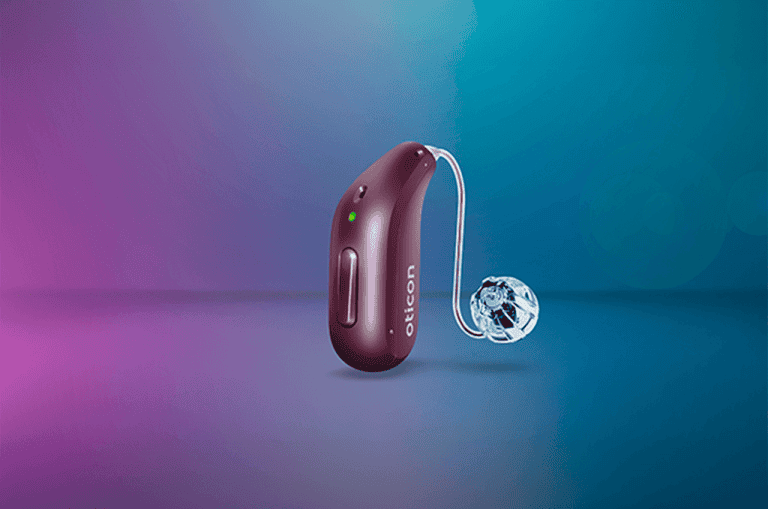





Oticon Intent and Oticon Real are both premium receiver-in-canal hearing-aid families, but Intent introduced a major change in how Oticon tries to interpret the listener’s needs. Real focuses on giving access to useful sound while reducing disruptive everyday sounds. Intent adds 4D user-intent sensing to help the hearing aids respond to changing listening behaviour.
Oticon Intent vs Real in simple terms
- Intent: newer sensor-driven platform, rechargeable options, 4D user-intent information and current connectivity.
- Real: established premium BrainHearing platform focused on preserving useful environmental sound while managing wind, handling and sudden-sound disruption.
What are the 4D sensors in Intent?
Intent combines information about head movement, body movement, conversation activity and the acoustic environment. The goal is to give the system additional context about what the wearer may be trying to do in the moment.
Read the full Oticon Intent guide for the clinical overview.
Does that make Real obsolete?
No. A newer platform does not automatically make an older premium hearing aid clinically unsuitable. Real can still be a sensible route when its fitting range, price, handling, connectivity and available technology level match the patient well. Local stock and supplier support also matter.
Speech in noise
Patients often ask whether Intent is automatically better in restaurants or groups. The correct answer is more nuanced. Sensor information may help the system adapt differently, but individual benefit still depends on hearing loss, speech discrimination, ear coupling, programming and the exact listening environment.
Wind and sudden sounds
Real was specifically developed around reducing the disruption of wind, handling noise and sudden sounds while preserving access to the surrounding sound scene. Those remain useful design goals, particularly for active patients.
Connectivity and accessories
Connectivity evolves across generations, so compatibility should be checked against the exact model, phone and accessory rather than assuming all Oticon devices work identically. Newer Bluetooth standards are explained in our hearing-aid Bluetooth guide.
Price can change the decision
If a Real configuration is available at a materially different price from Intent, the relevant question is whether the additional Intent features are likely to matter for the patient’s listening profile. Our Oticon pricing guide explains the factors behind quotes.
Both still need a proper fitting
Premium technology does not remove the need for verification. Real-ear measurement is used where appropriate to check the output delivered in the individual ear against prescribed targets.
Which one should you choose?
Intent is the more logical starting point when the newest sensor-driven Oticon technology is a priority. Real may remain relevant when the patient prefers the established platform, the price is attractive, or the exact configuration is a better practical fit. We compare both with other suitable Oticon and non-Oticon options through our multi-brand hearing-aid service.
Oticon hearing aids in Bryanston
Our practice in Bryanston sees patients from Sandton and greater Johannesburg for diagnostic hearing assessment, hearing-aid comparison, fitting, REM verification and follow-up. See our Oticon hearing aids overview for the wider current range.