



Custom hearing aids are built to sit inside the ear, but the labels IIC, CIC, ITC and ITE describe very different device sizes and fitting trade-offs. The smallest option is not automatically the best option.
The right custom style depends on the hearing loss, ear-canal anatomy, wax and moisture history, required output, microphone configuration, dexterity and how much visibility the wearer is comfortable with.
The short answer
IIC is the smallest and deepest custom style. CIC sits slightly farther out. ITC fills more of the canal and can create more space for components and controls. ITE is the largest in-ear custom style and is often easier to handle. Moving outward generally trades some discretion for more physical space and easier handling.

What does IIC mean?
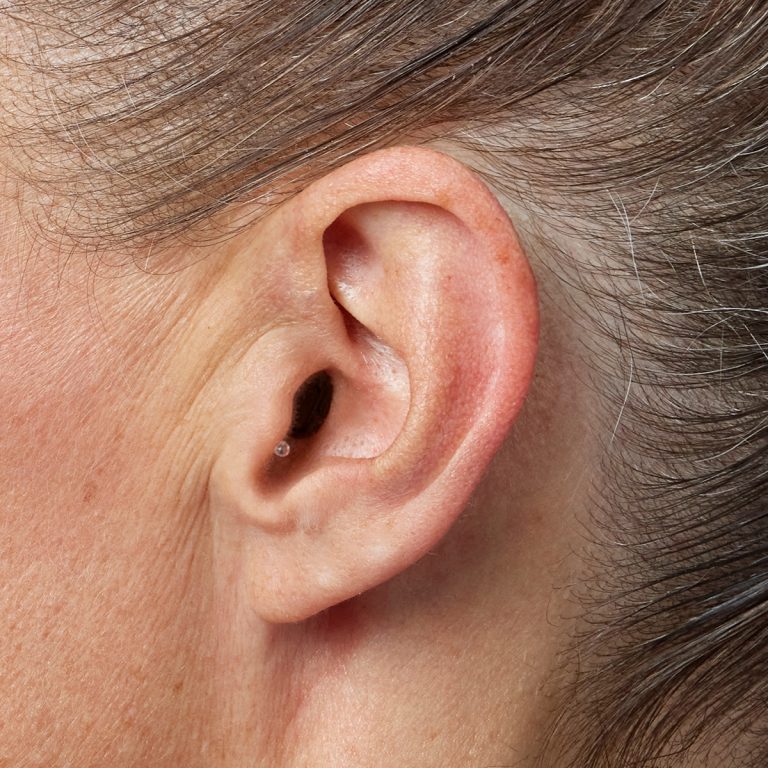
IIC stands for invisible-in-canal. It is designed to sit deep in the ear canal and is usually the least visible custom option when the ear anatomy allows it.
The advantage is discretion. The trade-off is space. A very small shell leaves less room for batteries or rechargeable components, controls, larger receivers and multiple microphones. A deep fit can also be less practical for someone with narrow canals, recurrent wax, poor dexterity or difficulty inserting a tiny device consistently.
What does CIC mean?
CIC stands for completely-in-canal. It remains very discreet but generally sits slightly farther out than an IIC. That small increase in shell size can make handling easier and may allow a different balance of output, battery or rechargeable design and controls, depending on the manufacturer.
Signia’s current custom range is a useful example of why the exact model matters. Its Insio IIC IX and CIC IX are one-microphone custom devices, while the larger ITC and ITE IX routes can use two microphones. Signia also offers a rechargeable Insio Charge&Go CIC IX as a separate custom route.
What does ITC mean?
ITC stands for in-the-canal. It occupies more of the canal opening than a CIC. For some wearers, this is the point where handling becomes noticeably easier because there is more device surface to hold and more room for physical controls or additional components.
A larger custom shell can also make a two-microphone arrangement possible in models that do not have enough physical separation between microphones at IIC or CIC size. That can matter for directional processing, although the actual technology differs by manufacturer and model.
What does ITE mean?
ITE stands for in-the-ear. It is the largest of these custom categories and may fill a substantial part of the outer ear. It is therefore the most visible of the four, but it can also be the easiest to insert, remove and manipulate.
The extra shell space may allow larger components, stronger output, larger controls or additional microphone options. This can make an ITE more appropriate than an IIC for a wearer whose priority is reliable handling rather than maximum discretion.
Why ear anatomy can overrule preference
A patient may arrive asking for the smallest possible hearing aid, but the ear canal has to accommodate the device safely and comfortably. Canal length, bends, diameter, jaw movement and the space required for the receiver and microphone all influence how small a custom shell can realistically be.
This is why a custom fitting begins with otoscopy and an ear impression when a manufactured shell is being ordered. The final shell size is partly determined by the ear itself.
Wax and moisture matter more with small in-ear devices
All in-ear devices sit closer to the ear canal environment than a conventional behind-the-ear hearing aid. Wax, moisture and skin debris can therefore affect microphones, receivers and wax guards more directly.
Someone with heavy recurrent wax may still be able to use a custom device, but maintenance needs should form part of the decision. A tiny hearing aid that repeatedly blocks or is difficult to clean is not a good practical fit simply because it looks discreet.
Which size is easiest to handle?
Generally, larger custom devices provide more surface area to grip and may allow larger physical controls. That can be helpful for arthritis, tremor, reduced sensation or vision difficulties. Rechargeability can simplify battery handling, but the patient still needs to insert the devices correctly and place them in the charger.
Which is best for hearing in noise?
There is no universal answer. Directional microphone design, fitting depth, venting, hearing loss and manufacturer processing all influence performance. A larger ITC or ITE can sometimes accommodate two microphones where a smaller one-microphone device cannot, but modern manufacturers also use specialised one-microphone strategies in selected CIC and IIC products.
The useful comparison is therefore between the actual devices being considered, not only the shell labels.
Where Signia Silk fits into this conversation
Signia Silk Charge&Go IX looks like a small in-canal hearing aid, but it is not manufactured as an individual custom shell in the same way as Insio. Silk is a ready-to-wear CIC-style device using sleeves or selected coupling. That makes Silk vs Insio a separate decision from IIC vs CIC vs ITC vs ITE.
Frequently asked questions
Is an IIC always invisible?
No. Visibility depends on the individual ear, shell size, canal shape and viewing angle. “Invisible” describes the product category rather than a guarantee that no part of the device will ever be seen.
Are bigger custom hearing aids less advanced?
No. A larger shell can actually allow more components, controls or microphone options. Size and technology level are separate decisions.
Do custom hearing aids need real-ear measurement?
Verification is still important. The exact verification approach can depend on the device and fitting, but a custom shell does not remove the need to confirm that the acoustic output is appropriate.
Choose the smallest device that still works well for you
We fit custom and discreet hearing aids in Bryanston after assessing hearing, ear anatomy, handling and real-world listening needs. The goal is not simply to hide the device. It is to make the fitting practical and effective.
Related Signia guide
See our Signia custom and discreet hearing-aid page for current Silk and Insio options. Signia’s current professional portfolio lists one-microphone Insio IIC/CIC and two-microphone ITC/ITE configurations.